Driven Systems and Dynamical Decoupling
In this page, we show how to solve the time evolution with time-dependent Hamiltonian problems in hierarchical equations of motion approach.
using HierarchicalEOM
using LaTeXStrings
import Plots
Here, we study dynamical decoupling which is a common tool used to undo the dephasing effect from the environment even for finite pulse duration.
Hamiltonian
We consider a two-level system coupled to a bosonic reservoir ($\textrm{b}$). The total Hamiltonian is given by $H_{\textrm{T}}=H_\textrm{s}+H_\textrm{b}+H_\textrm{sb}$, where each terms takes the form
\[\begin{aligned} H_{\textrm{s}}(t) &= H_0 + H_{\textrm{D}}(t),\\ H_0 &= \frac{\omega_0}{2} \sigma_z,\\ H_{\textrm{b}} &=\sum_{k}\omega_{k}b_{k}^{\dagger}b_{k},\\ H_{\textrm{sb}} &=\sigma_z\sum_{k}g_{\alpha,k}(b_k + b_k^{\dagger}). \end{aligned}\]
Here, $H_{\textrm{b}}$ describes a bosonic reservoir where $b_{k}$ $(b_{k}^{\dagger})$ is the bosonic annihilation (creation) operator associated to the $k$th mode (with frequency $\omega_{k}$).
Furthermore, to observe the time evolution of the coherence, we consider the initial state to be
\[ψ(t=0)=\frac{1}{\sqrt{2}}\left(|0\rangle+|1\rangle\right)\]
ω0 = 0.0
σz = [1 0; 0 -1]
σx = [0 1; 1 0]
H0 = 0.5 * ω0 * σz

ρ0 = 0.5 * [1 1; 1 1];
The time-dependent driving term $H_{\textrm{D}}(t)$ has the form
\[H_{\textrm{D}}(t) = \sum_{n=1}^N f_n(t) \sigma_x\]
where the pulse is chosen to have duration $\tau$ together with a delay $\Delta$ between each pulses, namely
\[f_n(t) = \begin{cases} V & \textrm{if}~~(n-1)\tau + n\Delta \leq t \leq n (\tau + \Delta),\\ 0 & \textrm{otherwise}. \end{cases}\]
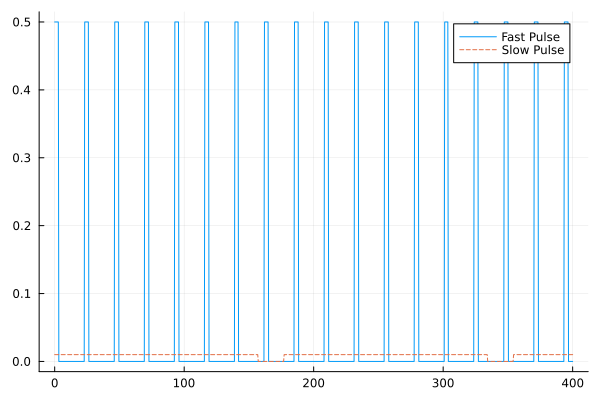
Here, we set the period of the pulses to be $\tau V = \pi/2$. Therefore, we consider two scenarios with fast and slow pulses:
# a function which returns the amplitude of the pulse at time t
function pulse(V, Δ, t)
    τ = 0.5 * π / V
    period = τ + Δ

    if (t % period) < τ
        return V
    else
        return 0
    end
end

tlist = 0:0.4:400
amp_fast = 0.50
amp_slow = 0.01
delay = 20

Plots.plot(
    tlist,
    [[pulse(amp_fast, delay, t) for t in tlist], [pulse(amp_slow, delay, t) for t in tlist]],
    label = ["Fast Pulse" "Slow Pulse"],
    linestyle = [:solid :dash],
)
Construct bath objects
We assume the bosonic reservoir to have a Drude-Lorentz Spectral Density, and we utilize the Padé decomposition. Furthermore, the spectral densities depend on the following physical parameters:
- the coupling strength $\Gamma$ between system and reservoir
- the band-width $W$
- the product of the Boltzmann constant $k$ and the absolute temperature $T$ : $kT$
- the total number of exponentials for the reservoir $(N + 1)$
Γ = 0.0005
W = 0.005
kT = 0.05
N = 3
bath = Boson_DrudeLorentz_Pade(σz, Γ, W, kT, N)
BosonBath object with (system) dim = 2 and 4 exponential-expansion terms
Construct HEOMLS matrix
(see also HEOMLS Matrix for Bosonic Baths)
Only provide the time-independent part of system Hamiltonian when constructing HEOMLS matrices (the time-dependent part should be given when solving the time evolution).
tier = 6
M = M_Boson(H0, tier, bath)
Boson type HEOMLS matrix acting on even-parity ADOs
system dim = 2
number of ADOs N = 210
data =
840×840 SparseArrays.SparseMatrixCSC{ComplexF64, Int64} with 3104 stored entries:
⎡⣻⢞⣦⡀⠀⠘⢦⡀⠀⠀⠀⠀⠀⠀⠀⠀⠳⣄⠀⠀⠀⠀⠀⠀⠀⠀⠀⠀⠀⠀⠀⠀⠀⠀⠀⠀⠀⠀⠀⠀⎤
⎢⠈⠻⣿⣿⣄⠀⠀⠙⣄⠀⠀⠀⠀⠀⠀⠀⠀⠈⢣⡀⠀⠀⠀⠀⠀⠀⠀⠀⠀⠀⠀⠀⠀⠀⠀⠀⠀⠀⠀⠀⎥
⎢⣀⠀⠀⠙⠿⢇⣀⡀⠈⢇⠀⠀⠀⠀⠀⠀⠀⠀⠀⠹⡀⠀⠀⠀⠀⠀⠀⠀⠀⠀⠀⠀⠀⠀⠀⠀⠀⠀⠀⠀⎥
⎢⠈⠳⣄⠀⠀⠸⣿⣿⣄⠀⠳⡄⠀⠀⠀⠀⠀⠀⠀⠀⠈⢦⡀⠀⠀⠀⠀⠀⠀⠀⠀⠀⠀⠀⠀⠀⠀⠀⠀⠀⎥
⎢⠀⠀⠀⠙⠦⢄⠀⠙⠿⢇⣀⠘⣆⠀⠀⠀⠀⠀⠀⠀⠀⠀⢱⡀⠀⠀⠀⠀⠀⠀⠀⠀⠀⠀⠀⠀⠀⠀⠀⠀⎥
⎢⠀⠀⠀⠀⠀⠀⠙⠦⣀⠘⢿⣷⡌⠳⡀⠀⠀⠀⠀⠀⠀⠀⠀⠙⢆⠀⠀⠀⠀⠀⠀⠀⠀⠀⠀⠀⠀⠀⠀⠀⎥
⎢⠀⠀⠀⠀⠀⠀⠀⠀⠈⠙⢦⡉⢿⣷⡳⡄⠀⠀⠀⠀⠀⠀⠀⠀⠘⢦⠀⠀⠀⠀⠀⠀⠀⠀⠀⠀⠀⠀⠀⠀⎥
⎢⠀⠀⠀⠀⠀⠀⠀⠀⠀⠀⠀⠈⠙⠮⣿⣿⠀⠀⠀⠀⠀⠀⠀⠀⠀⠈⠧⠀⠀⠀⠀⠀⠀⠀⠀⠀⠀⠀⠀⠀⎥
⎢⠙⢦⡀⠀⠀⠀⠀⠀⠀⠀⠀⠀⠀⠀⠀⠀⣿⣿⣆⠀⠓⣄⠀⠀⠀⠀⠈⢣⡀⠀⠀⠀⠀⠀⠀⠀⠀⠀⠀⠀⎥
⎢⠀⠀⠉⠳⣄⡀⠀⠀⠀⠀⠀⠀⠀⠀⠀⠀⠈⠙⢿⣷⠀⠈⢣⠀⠀⠀⠀⠀⠙⡄⠀⠀⠀⠀⠀⠀⠀⠀⠀⠀⎥
⎢⠀⠀⠀⠀⠀⠈⠲⣄⠀⠀⠀⠀⠀⠀⠀⠀⠙⢤⡀⠀⢟⣵⣌⠳⡄⠀⠀⠀⠀⠉⢦⠀⠀⠀⠀⠀⠀⠀⠀⠀⎥
⎢⠀⠀⠀⠀⠀⠀⠀⠈⠙⠲⣄⠀⠀⠀⠀⠀⠀⠀⠉⠒⢦⡙⢻⣶⡽⣄⠀⠀⠀⠀⠀⢣⡀⠀⠀⠀⠀⠀⠀⠀⎥
⎢⠀⠀⠀⠀⠀⠀⠀⠀⠀⠀⠈⠙⠲⣄⡀⠀⠀⠀⠀⠀⠀⠉⠓⢯⣻⣾⣆⠀⠀⠀⠀⠀⠳⡀⠀⠀⠀⠀⠀⠀⎥
⎢⠀⠀⠀⠀⠀⠀⠀⠀⠀⠀⠀⠀⠀⠀⠉⠃⢦⣀⠀⠀⠀⠀⠀⠀⠈⠙⢱⣶⣄⠲⣄⠀⠀⠢⡀⠀⠀⠀⠀⠀⎥
⎢⠀⠀⠀⠀⠀⠀⠀⠀⠀⠀⠀⠀⠀⠀⠀⠀⠀⠈⠓⠤⣄⠀⠀⠀⠀⠀⢠⡙⠻⣦⣜⣆⠀⠀⠙⣄⠀⠀⠀⠀⎥
⎢⠀⠀⠀⠀⠀⠀⠀⠀⠀⠀⠀⠀⠀⠀⠀⠀⠀⠀⠀⠀⠈⠓⠤⣀⠀⠀⠀⠙⠲⢽⡿⣯⣧⠀⠀⠈⣆⠀⠀⠀⎥
⎢⠀⠀⠀⠀⠀⠀⠀⠀⠀⠀⠀⠀⠀⠀⠀⠀⠀⠀⠀⠀⠀⠀⠀⠈⠙⠢⢤⣀⠀⠀⠉⠛⠿⣧⡄⢄⠘⡄⠀⠀⎥
⎢⠀⠀⠀⠀⠀⠀⠀⠀⠀⠀⠀⠀⠀⠀⠀⠀⠀⠀⠀⠀⠀⠀⠀⠀⠀⠀⠀⠈⠓⢤⣀⠀⠀⢍⡛⣬⣦⠘⢆⠀⎥
⎢⠀⠀⠀⠀⠀⠀⠀⠀⠀⠀⠀⠀⠀⠀⠀⠀⠀⠀⠀⠀⠀⠀⠀⠀⠀⠀⠀⠀⠀⠀⠈⠙⠒⢦⣈⠛⠛⣤⣬⡄⎥
⎣⠀⠀⠀⠀⠀⠀⠀⠀⠀⠀⠀⠀⠀⠀⠀⠀⠀⠀⠀⠀⠀⠀⠀⠀⠀⠀⠀⠀⠀⠀⠀⠀⠀⠀⠈⠙⠒⠿⣿⢟⎦time evolution with time-independent Hamiltonian
(see also Time Evolution)
noPulseResult = evolution(M, ρ0, tlist);Solving time evolution for ADOs by Ordinary Differential Equations method...
Progress : 39%|███████▉ | ETA: 0:00:00 ( 0.26 ms/it)
Progress : 94%|██████████████████▊ | ETA: 0:00:00 ( 0.21 ms/it)[DONE]Solve time evolution with time-dependent Hamiltonian
(see also Time Evolution)
We need to provide a user-defined function (named as H_D in this case), which must be in the form H_D(p::Tuple, t) and returns the time-dependent part of system Hamiltonian (in AbstractMatrix type) at any given time point t. The parameter p should be a Tuple which contains all the extra parameters [V (amplitude), Δ (delay), and σx (operator) in this case] for the function H_D:
function H_D(p::Tuple, t)
    V, Δ, σx = p
    return pulse(V, Δ, t) * σx
end;
The parameter tuple p will be passed to your function H_D directly from the last required parameter in evolution:
fastTuple = (amp_fast, delay, σx)
slowTuple = (amp_slow, delay, σx)

fastPulseResult = evolution(M, ρ0, tlist, H_D, fastTuple);
slowPulseResult = evolution(M, ρ0, tlist, H_D, slowTuple);
Solving time evolution for ADOs with time-dependent Hamiltonian by Ordinary Differential Equations method...
Solving time evolution for ADOs with time-dependent Hamiltonian by Ordinary Differential Equations method...
Progress : 0%| | ETA: 0:18:43 ( 1.12 s/it)
Progress : 33%|██████▋ | ETA: 0:00:03 ( 3.80 ms/it)
Progress : 61%|████████████▏ | ETA: 0:00:01 ( 2.24 ms/it)
Progress : 88%|█████████████████▌ | ETA: 0:00:00 ( 1.74 ms/it)[DONE]
Solving time evolution for ADOs with time-dependent Hamiltonian by Ordinary Differential Equations method...
Solving time evolution for ADOs with time-dependent Hamiltonian by Ordinary Differential Equations method...
Progress : 20%|████ | ETA: 0:00:00 ( 0.52 ms/it)
Progress : 39%|███████▉ | ETA: 0:00:00 ( 0.55 ms/it)
Progress : 60%|████████████ | ETA: 0:00:00 ( 0.53 ms/it)
Progress : 80%|███████████████▉ | ETA: 0:00:00 ( 0.54 ms/it)[DONE]Measure the coherence
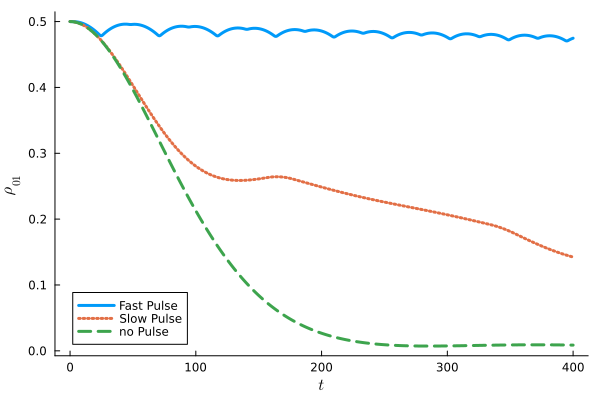
One can use the built-in function Expect to calculate the expectation value from a given observable and ADOs:
# Define the operator that measures the 0, 1 element of density matrix
ρ01 = [0 1; 0 0]

Plots.plot(
    tlist,
    [Expect(ρ01, fastPulseResult), Expect(ρ01, slowPulseResult), Expect(ρ01, noPulseResult)],
    label = ["Fast Pulse" "Slow Pulse" "no Pulse"],
    linestyle = [:solid :dot :dash],
    linewidth = 3,
    xlabel = L"t",
    ylabel = L"\rho_{01}",
    grid = false,
)
This example is from QuTiP-BoFiN paper : Phys. Rev. Research 5, 013181 (2023).
This page was generated using Literate.jl.