Cavity QED system
Cavity quantum electrodynamics (cavity QED) is an important topic for studying the interaction between atoms (or other particles) and light confined in a reflective cavity, under conditions where the quantum nature of photons is significant.
using HierarchicalEOM
using LaTeXStrings
import QuantumToolbox, Plots
Hamiltonian
The Jaynes-Cummings model is a standard model in the realm of cavity QED. It illustrates the interaction between a two-level atom ($\textrm{A}$) and a quantized single-mode within a cavity ($\textrm{c}$).
\[\begin{aligned} H_{\textrm{s}}&=H_{\textrm{A}}+H_{\textrm{c}}+H_{\textrm{int}},\\ H_{\textrm{A}}&=\frac{\omega_A}{2}\sigma_z,\\ H_{\textrm{c}}&=\omega_{\textrm{c}} a^\dagger a,\\ H_{\textrm{int}}&=g (a^\dagger\sigma^-+a\sigma^+), \end{aligned}\]
where $\sigma^-$ ($\sigma^+$) is the annihilation (creation) operator of the atom, and $a$ ($a^\dagger$) is the annihilation (creation) operator of the cavity.
Furthermore, we consider the system is coupled to a bosonic reservoir ($\textrm{b}$). The total Hamiltonian is given by $H_{\textrm{Total}}=H_\textrm{s}+H_\textrm{b}+H_\textrm{sb}$, where $H_\textrm{b}$ and $H_\textrm{sb}$ takes the form
\[\begin{aligned} H_{\textrm{b}} &=\sum_{k}\omega_{k}b_{k}^{\dagger}b_{k},\\ H_{\textrm{sb}} &=(a+a^\dagger)\sum_{k}g_{k}(b_k + b_k^{\dagger}). \end{aligned}\]
Here, $H_{\textrm{b}}$ describes a bosonic reservoir where $b_{k}$ $(b_{k}^{\dagger})$ is the bosonic annihilation (creation) operator associated to the $k$th mode (with frequency $\omega_{k}$). Also, $H_{\textrm{sb}}$ illustrates the interaction between the cavity and the bosonic reservoir.
Now, we can build the system Hamiltonian with the package QuantumToolbox.jl (optional) to construct the operators.
HierarchicalEOM.jl provides an extension to support QuantumToolbox-type object, but this feature requires Julia 1.9+ and HierarchicalEOM 1.4+. See here for more details.
N = 3 ## system cavity Hilbert space cutoff
ωA = 2
ωc = 2
g = 0.1

# operators
a_c = QuantumToolbox.destroy(N)
I_c = QuantumToolbox.qeye(N)
σz_A = QuantumToolbox.sigmaz()
σm_A = QuantumToolbox.sigmam()
I_A = QuantumToolbox.qeye(2)

# operators in tensor-space
a = QuantumToolbox.tensor(a_c, I_A)
σz = QuantumToolbox.tensor(I_c, σz_A)
σm = QuantumToolbox.tensor(I_c, σm_A)

# Hamiltonian
H_A = 0.5 * ωA * σz
H_c = ωc * a' * a
H_int = g * (a' * σm + a * σm')

H_s = H_A + H_c + H_int

# initial state
ket0 = QuantumToolbox.tensor(QuantumToolbox.basis(N, 0), QuantumToolbox.basis(2, 0))
ρ0 = QuantumToolbox.ket2dm(ket0);
Construct bath objects
We assume the bosonic reservoir to have a Drude-Lorentz Spectral Density, and we utilize the Padé decomposition. Furthermore, the spectral densities depend on the following physical parameters:
- the coupling strength $\Gamma$ between system and reservoir
- the band-width $W$
- the product of the Boltzmann constant $k$ and the absolute temperature $T$ : $kT$
- the total number of exponentials for the reservoir $(N + 1)$
Γ = 0.01
W = 1
kT = 0.025
N = 20
Bath = Boson_DrudeLorentz_Pade(a + a', Γ, W, kT, N)
BosonBath object with (system) dim = 6 and 21 exponential-expansion terms
Before incorporating the correlation function into the HEOMLS matrix, it is essential to verify if the total number of exponentials for the reservoir sufficiently describes the practical situation.
tlist_test = 0:0.1:10;

Bath_test = Boson_DrudeLorentz_Pade(a + a', Γ, W, kT, 1000);
Ct = C(Bath, tlist_test);
Ct2 = C(Bath_test, tlist_test);

Plots.plot(tlist_test, real(Ct), label = "N=20 (real part )", linestyle = :dash, linewidth = 3)
Plots.plot!(tlist_test, real(Ct2), label = "N=1000 (real part)", linestyle = :solid, linewidth = 3)
Plots.plot!(tlist_test, imag(Ct), label = "N=20 (imag part)", linestyle = :dash, linewidth = 3)
Plots.plot!(tlist_test, imag(Ct2), label = "N=1000 (imag part)", linestyle = :solid, linewidth = 3)

Plots.xaxis!("t")
Plots.yaxis!("C(t)")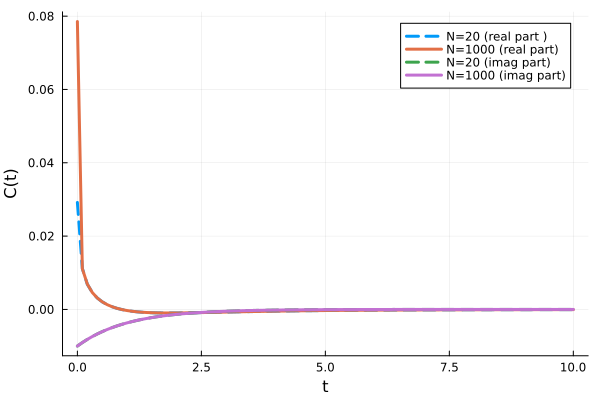
Construct HEOMLS matrix
(see also HEOMLS Matrix for Bosonic Baths) Here, we consider an incoherent pumping to the atom, which can be described by an Lindblad dissipator (see here for more details).
Furthermore, we set the important threshold to be 1e-6.
pump = 0.01
J_pump = sqrt(pump) * σm'

tier = 2
M_Heom = M_Boson(H_s, tier, threshold = 1e-6, Bath)
M_Heom = addBosonDissipator(M_Heom, J_pump)
Boson type HEOMLS matrix acting on even-parity ADOs
system dim = 6
number of ADOs N = 97
data =
3492×3492 SparseArrays.SparseMatrixCSC{ComplexF64, Int64} with 40314 stored entries:
⎡⣿⣿⡛⠛⠛⠛⠃⠈⠃⠀⠀⠀⠈⠃⠀⠛⠀⠀⠛⠀⠀⠙⠀⠀⠀⠘⠀⠀⠀⠀⠀⠀⣃⠀⠀⠀⠀⠀⠀⠀⎤
⎢⣿⠈⠻⢆⡀⠀⠀⠀⠻⢦⡀⠀⠀⠀⠀⠀⠀⠀⠀⠀⠀⠀⠀⠀⠀⠐⢦⡀⠀⠀⠀⠀⠙⠷⣄⠀⠀⠀⠀⠀⎥
⎢⣿⠀⠀⠈⠻⣦⣶⣄⠀⠀⠻⣦⡀⢤⡀⢠⣄⠀⢠⣀⠀⠰⣦⡀⠀⠀⠀⠙⢦⡀⠀⠀⠀⠀⠙⢷⣄⠀⠀⠀⎥
⎢⡉⠀⠀⠀⠘⢿⡿⣯⣀⣀⣀⣀⣁⠀⢁⠀⢈⡀⠀⢉⠀⠀⠀⣁⠀⠀⠀⠀⠀⢉⠀⠀⠀⠀⠀⠀⢈⡀⠀⠀⎥
⎢⠉⠀⠻⣆⠀⠀⠀⢸⡿⣯⡉⠉⠉⠀⠈⠀⠈⠁⠀⠈⠁⠀⠀⠉⠀⠀⠀⠀⠀⠈⠀⠀⠀⠀⠀⠀⠈⠁⠀⠀⎥
⎢⠀⠀⠀⠈⠻⣦⠀⢸⡇⠈⠻⣦⡀⠀⠀⠀⠀⠀⠀⠀⠀⠀⠀⠀⠀⠀⠀⠀⠀⠀⠀⠀⠀⠀⠀⠀⠀⠀⠀⠀⎥
⎢⠦⠀⠀⠀⠀⣌⠁⠘⠃⠀⠀⠈⢻⣶⡶⠆⠀⠶⠀⠀⠦⠀⠀⠰⠆⠀⠀⠀⠀⠰⠆⠀⠀⠀⠀⠀⠀⠶⠀⠀⎥
⎢⣤⠀⠀⠀⠀⣈⠁⠐⠂⠀⠀⠀⠸⠏⠱⣦⣤⣤⡄⠀⢠⡀⠀⠀⣤⠀⠀⠀⠀⠀⣤⠀⠀⠀⠀⠀⠀⢠⡄⠀⎥
⎢⠀⠀⠀⠀⠀⠙⠂⠰⠆⠀⠀⠀⢠⡄⠀⣿⠻⣦⡀⠀⠀⠀⠀⠀⠀⠀⠀⠀⠀⠀⠀⠀⠀⠀⠀⠀⠀⠀⠀⠀⎥
⎢⠛⠀⠀⠀⠀⢲⡄⢀⡀⠀⠀⠀⠀⠀⠀⠉⠀⠈⣿⣿⡛⠃⠀⠀⠘⠃⠀⠀⠀⠀⠘⠃⠀⠀⠀⠀⠀⠀⠛⠀⎥
⎢⣄⠀⠀⠀⢀⡀⠀⠀⠁⠀⠀⠀⠈⠃⠀⠲⠀⠀⠿⠈⠻⣦⣤⣤⣤⡄⠀⠀⠀⠀⠀⣄⠀⠀⠀⠀⠀⠀⢠⠀⎥
⎢⠀⠀⠀⠀⠈⠻⠄⢠⡄⠀⠀⠀⢀⡀⠀⠀⠀⠀⠀⠀⠀⣿⠻⣦⡀⠀⠀⠀⠀⠀⠀⠀⠀⠀⠀⠀⠀⠀⠀⠀⎥
⎢⣀⠀⢀⠀⠀⠀⠀⠀⠀⠀⠀⠀⠈⠁⠀⠛⠀⠀⠶⠀⠀⠿⠀⠈⠻⢆⣀⣀⣀⣀⣀⣀⡀⠀⠀⠀⠀⠀⢀⡀⎥
⎢⠀⠀⠈⠳⣄⠀⠀⠀⠀⠀⠀⠀⠀⠀⠀⠀⠀⠀⠀⠀⠀⠀⠀⠀⠀⢸⠻⣦⡀⠀⠀⠀⠀⠀⠀⠀⠀⠀⠀⠀⎥
⎢⠀⠀⠀⠀⠈⠳⡄⢀⡀⠀⠀⠀⢀⡀⠀⠀⠀⠀⠀⠀⠀⠀⠀⠀⠀⢸⠀⠈⠻⣦⡀⠀⠀⠀⠀⠀⠀⠀⠀⠀⎥
⎢⠀⠀⠀⠀⠀⠀⠀⠀⠀⠀⠀⠀⠈⠁⠀⠛⠀⠀⠶⠀⠀⢤⠀⠀⠀⢸⠀⠀⠀⠈⠻⣦⡀⠀⠀⠀⠀⠀⠀⠀⎥
⎢⠉⠘⢷⡄⠀⠀⠀⠀⠀⠀⠀⠀⠀⠀⠀⠀⠀⠀⠀⠀⠀⠀⠀⠀⠀⠈⠀⠀⠀⠀⠀⠈⡿⣯⡉⠉⠉⠉⠉⠉⎥
⎢⠀⠀⠀⠙⢷⣄⠀⠀⠀⠀⠀⠀⠀⠀⠀⠀⠀⠀⠀⠀⠀⠀⠀⠀⠀⠀⠀⠀⠀⠀⠀⠀⡇⠈⠻⣦⡀⠀⠀⠀⎥
⎢⠀⠀⠀⠀⠀⠙⠂⠰⠆⠀⠀⠀⢠⡄⠀⣀⠀⠀⠀⠀⠀⠀⠀⠀⠀⠀⠀⠀⠀⠀⠀⠀⡇⠀⠀⠈⠱⣦⡀⠀⎥
⎣⠀⠀⠀⠀⠀⠀⠀⠀⠀⠀⠀⠀⠀⠀⠀⠉⠀⠀⠛⠀⠀⠒⠀⠀⠀⠰⠀⠀⠀⠀⠀⠀⡇⠀⠀⠀⠀⠈⠻⣦⎦Solve time evolution of ADOs
(see also Time Evolution)
t_list = 0:1:500
evo_H = evolution(M_Heom, ρ0, t_list);
Solving time evolution for ADOs by Ordinary Differential Equations method...
Progress : 3%|▋ | ETA: 0:00:04 ( 7.57 ms/it)
Progress : 6%|█▎ | ETA: 0:00:03 ( 7.21 ms/it)
Progress : 9%|█▊ | ETA: 0:00:03 ( 7.08 ms/it)
Progress : 12%|██▍ | ETA: 0:00:03 ( 7.02 ms/it)
Progress : 15%|███ | ETA: 0:00:03 ( 6.98 ms/it)
Progress : 18%|███▋ | ETA: 0:00:03 ( 6.96 ms/it)
Progress : 21%|████▎ | ETA: 0:00:03 ( 7.02 ms/it)
Progress : 24%|████▊ | ETA: 0:00:03 ( 6.99 ms/it)
Progress : 27%|█████▍ | ETA: 0:00:03 ( 6.97 ms/it)
Progress : 30%|██████ | ETA: 0:00:02 ( 6.96 ms/it)
Progress : 33%|██████▋ | ETA: 0:00:02 ( 6.95 ms/it)
Progress : 36%|███████▏ | ETA: 0:00:02 ( 6.94 ms/it)
Progress : 39%|███████▊ | ETA: 0:00:02 ( 6.93 ms/it)
Progress : 42%|████████▍ | ETA: 0:00:02 ( 6.93 ms/it)
Progress : 45%|█████████ | ETA: 0:00:02 ( 6.93 ms/it)
Progress : 48%|█████████▋ | ETA: 0:00:02 ( 6.92 ms/it)
Progress : 51%|██████████▏ | ETA: 0:00:02 ( 7.09 ms/it)
Progress : 53%|██████████▊ | ETA: 0:00:02 ( 7.13 ms/it)
Progress : 56%|███████████▎ | ETA: 0:00:02 ( 7.11 ms/it)
Progress : 59%|███████████▉ | ETA: 0:00:01 ( 7.10 ms/it)
Progress : 62%|████████████▌ | ETA: 0:00:01 ( 7.08 ms/it)
Progress : 65%|█████████████▏ | ETA: 0:00:01 ( 7.07 ms/it)
Progress : 68%|█████████████▊ | ETA: 0:00:01 ( 7.06 ms/it)
Progress : 71%|██████████████▎ | ETA: 0:00:01 ( 7.05 ms/it)
Progress : 74%|██████████████▉ | ETA: 0:00:01 ( 7.04 ms/it)
Progress : 77%|███████████████▌ | ETA: 0:00:01 ( 7.04 ms/it)
Progress : 80%|████████████████▏ | ETA: 0:00:01 ( 7.03 ms/it)
Progress : 83%|████████████████▋ | ETA: 0:00:01 ( 7.20 ms/it)
Progress : 86%|█████████████████▎ | ETA: 0:00:00 ( 7.19 ms/it)
Progress : 89%|█████████████████▉ | ETA: 0:00:00 ( 7.18 ms/it)
Progress : 92%|██████████████████▌ | ETA: 0:00:00 ( 7.17 ms/it)
Progress : 95%|███████████████████▏| ETA: 0:00:00 ( 7.17 ms/it)
Progress : 98%|███████████████████▋| ETA: 0:00:00 ( 7.16 ms/it)[DONE]Solve stationary state of ADOs
(see also Stationary State)
steady_H = SteadyState(M_Heom);Solving steady state for ADOs by linear-solve method...[DONE]Expectation values
observable of atom: $\sigma_z$
σz_evo_H = Expect(σz, evo_H)
σz_steady_H = Expect(σz, steady_H)-0.37311739312829556observable of cavity: $a^\dagger a$ (average photon number)
np_evo_H = Expect(a' * a, evo_H)
np_steady_H = Expect(a' * a, steady_H)

p1 = Plots.plot(
    t_list,
    [σz_evo_H, ones(length(t_list)) .* σz_steady_H],
    label = [L"\langle \sigma_z \rangle" L"\langle \sigma_z \rangle ~~(\textrm{steady})"],
    linewidth = 3,
    linestyle = [:solid :dash],
)
p2 = Plots.plot(
    t_list,
    [np_evo_H, ones(length(t_list)) .* np_steady_H],
    label = [L"\langle a^\dagger a \rangle" L"\langle a^\dagger a \rangle ~~(\textrm{steady})"],
    linewidth = 3,
    linestyle = [:solid :dash],
)
Plots.plot(p1, p2, layout = [1, 1])
Plots.xaxis!("t")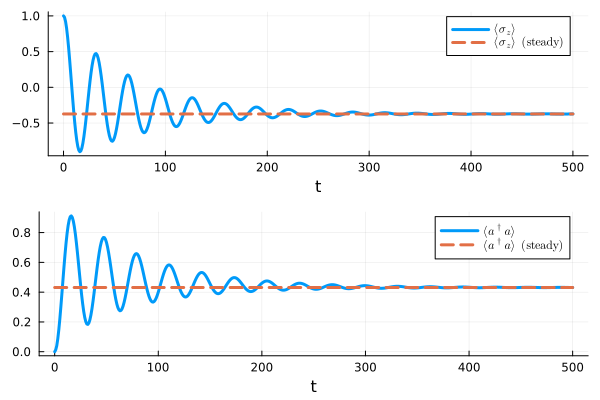
Power spectrum
(see also Spectrum)
ω_list = 1:0.01:3
psd_H = PowerSpectrum(M_Heom, steady_H, a, ω_list)

Plots.plot(ω_list, psd_H, linewidth = 3)
Plots.xaxis!(L"\omega")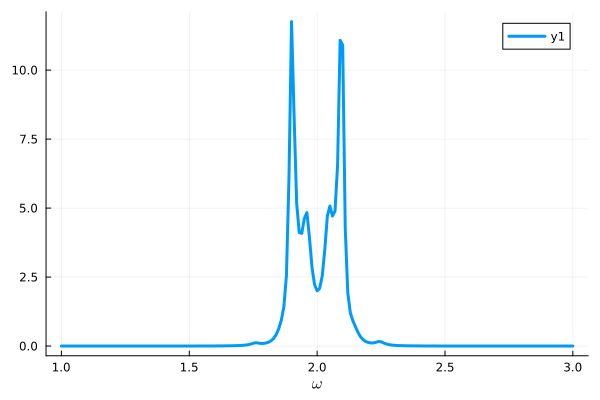
Compare with Master Eq. approach
(see also HEOMLS for Master Equations)
The Lindblad master equations which describs the cavity couples to an extra bosonic reservoir with Drude-Lorentzian spectral density is given by
# Drude_Lorentzian spectral density
Drude_Lorentz(ω, Γ, W) = 4 * Γ * W * ω / ((ω)^2 + (W)^2)

# Bose-Einstein distribution
n_b(ω, kT) = 1 / (exp(ω / kT) - 1)

# build the jump operators
jump_op =
    [sqrt(Drude_Lorentz(ωc, Γ, W) * (n_b(ωc, kT) + 1)) * a, sqrt(Drude_Lorentz(ωc, Γ, W) * (n_b(ωc, kT))) * a', J_pump];

# construct the HEOMLS matrix for master equation
M_master = M_S(H_s)
M_master = addBosonDissipator(M_master, jump_op)

# time evolution
evo_M = evolution(M_master, ρ0, t_list);

# steady
steady_M = SteadyState(M_master);

# expectation value of σz
σz_evo_M = Expect(σz, evo_M)
σz_steady_M = Expect(σz, steady_M)

# average photon number
np_evo_M = Expect(a' * a, evo_M)
np_steady_M = Expect(a' * a, steady_M)

p1 = Plots.plot(
    t_list,
    [σz_evo_M, ones(length(t_list)) .* σz_steady_M],
    label = [L"\langle \sigma_z \rangle" L"\langle \sigma_z \rangle ~~(\textrm{steady})"],
    linewidth = 3,
    linestyle = [:solid :dash],
)
p2 = Plots.plot(
    t_list,
    [np_evo_M, ones(length(t_list)) .* np_steady_M],
    label = [L"\langle a^\dagger a \rangle" L"\langle a^\dagger a \rangle ~~(\textrm{steady})"],
    linewidth = 3,
    linestyle = [:solid :dash],
)
Plots.plot(p1, p2, layout = [1, 1])
Plots.xaxis!("t")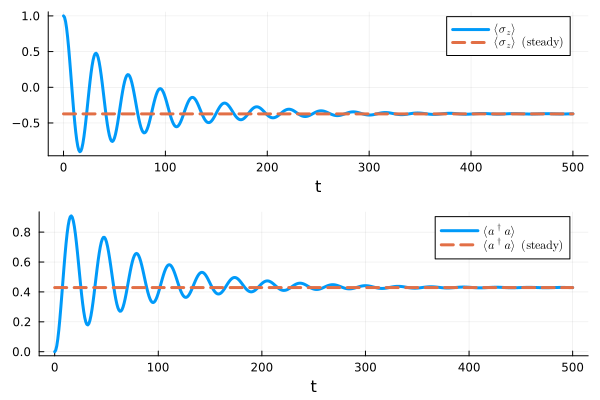
We can also calculate the power spectrum
ω_list = 1:0.01:3
psd_M = PowerSpectrum(M_master, steady_M, a, ω_list)

Plots.plot(ω_list, psd_M, linewidth = 3)
Plots.xaxis!(L"\omega")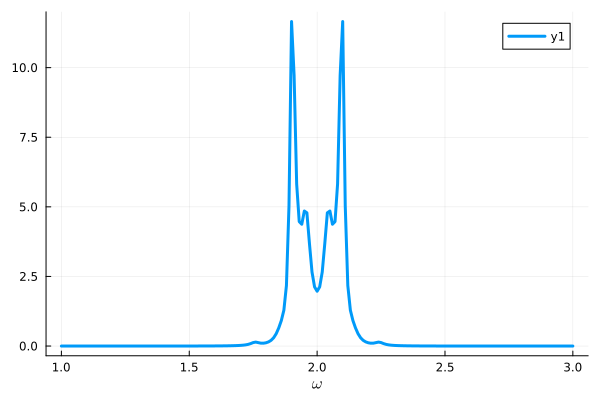
Due to the weak coupling between the system and an extra bosonic environment, the Master equation's outcome is expected to be similar to the results obtained from the HEOM method.
This page was generated using Literate.jl.